
Web Hosting Advice
Web Hosting Overselling Explained: When Unlimited Hosting Becomes a Problem
Learn how web hosting overselling works, when shared-resource planning becomes reckless, and which warning signs to check before choosing a host.
Published September 13, 2026 · Updated September 13, 2026
Copy everything below directly into the blog editor:
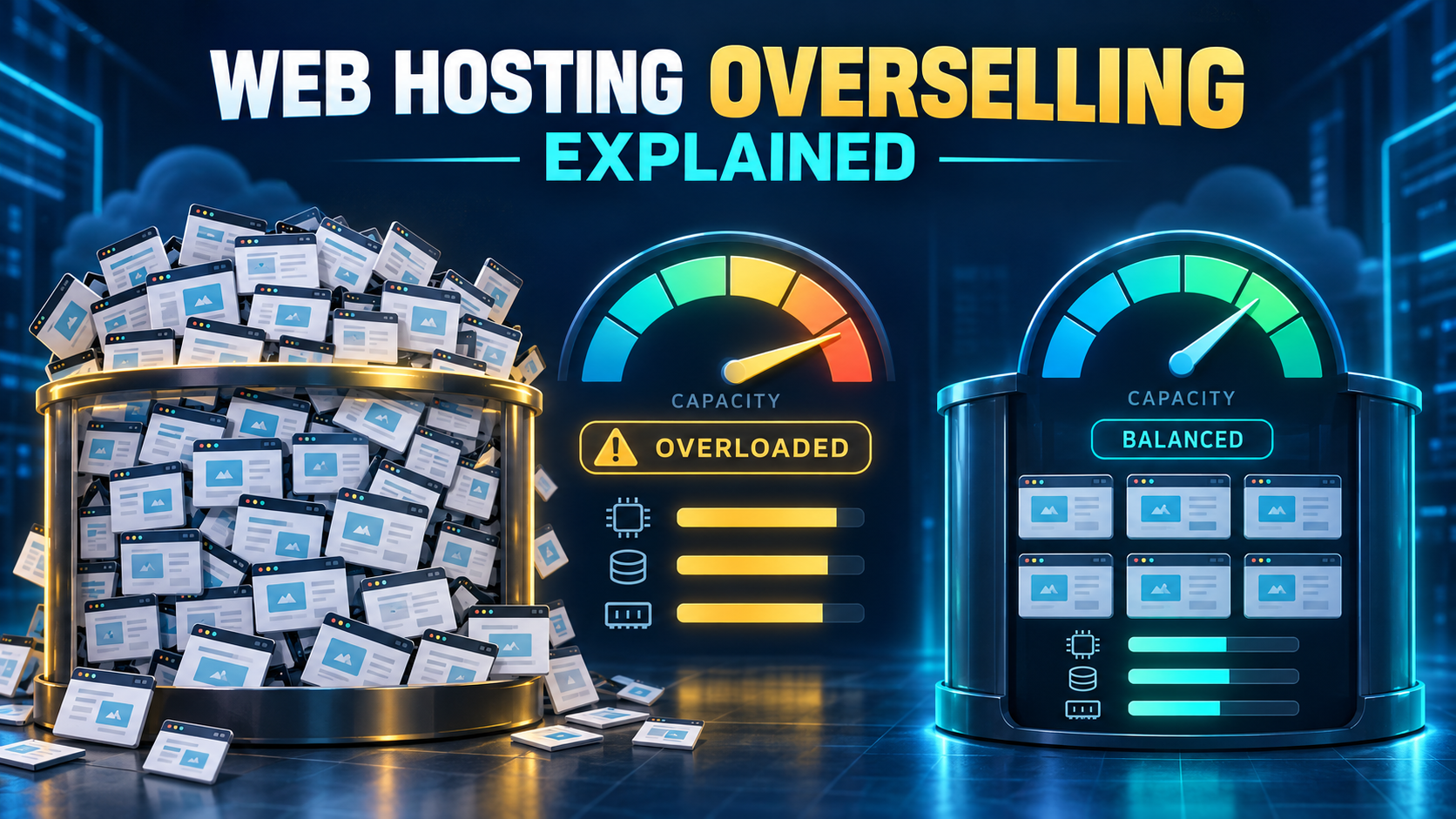
Web Hosting Overselling Explained: When Unlimited Hosting Becomes a ProblemWeb hosting overselling happens when a provider sells more storage, accounts, or computing capacity than it can reasonably deliver if customers use the service as advertised. It can lead to overloaded servers, slow websites, restrictive fine print, and plans that become unprofitable as soon as customers begin using the resources they purchased.
However, not every generous hosting feature is evidence of reckless overselling. Bandwidth is an important example. Modern servers and data centers often include enormous monthly transfer allocations or high-capacity unmetered ports. Because most ordinary websites use only a small portion of that capacity, a legitimate provider can offer unmetered or unlimited bandwidth while still operating comfortably within its network allocation.
The real issue is whether the provider understands its capacity, monitors actual consumption, maintains room for growth, and clearly explains which resources remain finite.
Key Takeaways
Unmetered bandwidth is not automatically a warning sign when the provider has substantial network capacity.
Unlimited bandwidth does not mean infinite transfer capacity. It normally means customers are not billed according to a routine monthly meter.
Storage, CPU, memory, disk I/O, inodes, database activity, backups, and cPanel accounts remain finite.
Responsible shared hosting uses measured capacity planning and account isolation.
Reckless overselling depends on customers never using the storage, accounts, or processing resources advertised to them.
What Does Web Hosting Overselling Mean?
Every server has physical limits. It contains a fixed amount of storage, CPU capacity, memory, and network connectivity. A provider could stop selling plans as soon as the advertised allowances equal those physical limits, but that would leave much of the server unused because customers rarely consume every resource simultaneously.
A website with a 25 GB storage allowance might use only 3 GB. A small business may receive generous bandwidth while transferring only a few gigabytes each month. Traffic spikes occur at different times, and many websites remain quiet for long periods. Responsible shared hosting uses these normal usage patterns to provide affordable service efficiently.
That approach becomes reckless when the provider sells so much theoretical capacity that normal customer growth causes the platform to fail. If a plan works only because customers are prevented from using what they bought, the service has moved beyond reasonable capacity planning and into overselling.
Why Bandwidth Is Different Today
Bandwidth was once one of the most expensive and restrictive parts of a hosting plan. Providers commonly sold plans with small monthly transfer limits and charged customers when they exceeded them. Modern data-center connectivity has changed that calculation.
Many legitimate hosting providers now receive very large monthly bandwidth allocations or unmetered connections limited primarily by port speed. Ordinary business websites, blogs, forums, and small online stores often consume only a small fraction of that available transfer capacity.
HTech Solutions receives 100 TB of monthly bandwidth on each server, and our actual usage remains far below that allocation. Even if a server hosted 1,000 websites, 100 TB would represent roughly 100 GB of average monthly transfer capacity per website. Most small-business websites use nowhere near that amount.
This is why HTech Solutions can offer unlimited bandwidth for normal hosted-site use without pretending that network resources are infinite. We are not advertising unlimited physical capacity. We are removing a routine customer-level transfer meter because the available server allocation comfortably supports normal usage.
Unmetered Versus Unlimited Bandwidth
The terms are often used interchangeably in hosting advertisements, but they describe slightly different ideas:
Metered bandwidth gives the customer a defined monthly transfer allowance.
Unmetered bandwidth normally means transfer is not billed by the gigabyte, while throughput remains limited by the network port and service policies.
Unlimited bandwidth generally means the provider does not impose a routine monthly transfer quota for normal website traffic.
None of these terms creates infinite network capacity. Port speed, upstream connectivity, responsible-use policies, and the physical server still establish boundaries. A responsible provider can explain those boundaries without hiding behind vague language.
The Resources That Are Still Genuinely Limited
Large bandwidth allocations do not make every hosting resource unlimited. The following resources require careful planning:
Storage Space
A server has a fixed amount of NVMe or SSD storage. Website files, databases, email, logs, temporary data, and backups all consume disk space. Selling unlimited storage on a small drive is far more difficult to justify than offering unmetered bandwidth backed by a large transfer allocation.
CPU and Memory
Dynamic websites use processor time and memory whenever PHP executes, a database query runs, a scheduled task begins, or a visitor loads uncached content. Busy or poorly optimized applications can affect neighboring accounts unless the server has adequate resources and proper isolation.
Disk I/O
Even when storage space remains available, too many simultaneous reads and writes can slow a server. Databases, backups, malware scans, email, and active websites all compete for disk performance.
Inodes
Every file and directory consumes an inode. A website can remain below its storage allowance while creating millions of small cache, session, email, or temporary files. Inode limits help prevent one account from overwhelming the filesystem.
Database and Entry Processes
Database connections, concurrent web requests, PHP workers, and entry processes are finite. These limits often affect a dynamic website before bandwidth becomes a concern.
Backups
Reliable backups require separate storage, retention planning, transfer capacity, and restore time. A provider offering backups should explain how often they run, where they are stored, and how customers can restore their data.
Responsible Capacity Planning Versus Reckless Overselling
Responsible Shared Hosting
Uses modern servers with sufficient CPU, memory, NVMe storage, and network capacity.
Monitors real bandwidth, disk, CPU, memory, database, and account usage.
Uses account isolation and resource controls to prevent one website from affecting others.
Maintains headroom for traffic spikes, migrations, updates, and customer growth.
Adds capacity or moves accounts before a server becomes saturated.
Publishes defined storage allowances and explains responsible-use policies.
Prices plans high enough to support licensing, security, backups, maintenance, and support.
Reckless Overselling
Advertises unlimited storage on infrastructure with clearly finite disk capacity.
Sells account allocations for less than their potential licensing cost.
Packs accounts onto undersized servers until customers report performance problems.
Uses hidden limits to prevent customers from consuming advertised resources.
Depends on multiple reseller layers with little direct control over the server.
Cannot afford capable support or dependable offsite backups at the advertised price.
How Reseller Hosting Can Be Oversold
Reseller hosting adds another layer to the capacity equation. A plan may allow its purchaser to create five, ten, twenty-five, or more separate cPanel accounts. Those accounts consume server storage and computing resources, and they can create direct control-panel licensing costs.
As of September 2026, cPanel’s publicly listed Premier Cloud license includes up to 100 accounts for $69.99 per month, with additional accounts priced at $0.49 each. Partner pricing can differ, and charges depend on accounts actually created rather than the maximum allocation advertised. Nevertheless, the public pricing demonstrates the underlying economics.
Consider a hypothetical reseller plan offering 25 cPanel accounts for $10 per month. Once a server exceeds the first 100 included accounts, 25 additional accounts represent $12.25 in potential monthly licensing charges:
25 accounts × $0.49 = $12.25 per month
That exceeds the plan’s entire $10 monthly revenue before paying for the server, security software, backup storage, payment processing, support, or taxes. The offer works only if customers create substantially fewer accounts than advertised, the provider accepts a loss, or an upstream arrangement changes the cost.
Offering more accounts than most customers use can be manageable when the provider prices and monitors the service responsibly. It becomes reckless when customers who use their full allowance automatically become unprofitable.
Warning Signs of an Oversold Hosting Provider
Unlimited everything: Unlimited storage, bandwidth, email, databases, and reseller accounts offered together for a few dollars.
Impossible pricing: The entire plan costs less than one of its advertised software or licensing components.
No infrastructure details: The provider cannot explain its platform, security, backups, data-center region, or support model.
Outdated information: Old control-panel screenshots and obsolete software lists are presented as current infrastructure.
Hidden restrictions: Important CPU, memory, inode, email, database, or backup limits are buried or unavailable.
Multiple reseller layers: Nobody dealing directly with the customer appears to control the underlying server.
Vague backup claims: “Free backups” are advertised without a schedule, retention period, storage location, or restoration process.
Questions to Ask Before Purchasing Hosting
What are the actual storage, CPU, memory, inode, database, and email limits?
Is bandwidth metered, unmetered, or subject to a defined transfer allowance?
What port speed and responsible-use policies apply?
Does the advertised price remain the same at renewal?
How many cPanel accounts may a reseller actually create?
Who controls WHM and the underlying server?
How are busy accounts isolated from neighboring customers?
How often are backups created, and are they stored off the server?
What happens when a server approaches capacity?
How HTech Solutions Approaches Capacity
HTech Solutions prices hosting to support dependable infrastructure rather than chasing the lowest possible headline price. Our platform uses NGINX, CloudLinux account isolation, Imunify360 security, NVMe storage, and offsite JetBackup protection. We monitor server resources and preserve room for growth instead of treating maximum saturation as the goal.
Each server includes 100 TB of monthly bandwidth, and actual transfer remains far below that allocation. That allows us to offer unlimited bandwidth for normal hosted websites without imposing an unnecessary monthly meter.
Storage is different. Hard drives, disk performance, and backup systems remain finite, so our hosting plans provide clearly defined storage allowances. Customers can select the capacity appropriate for their websites without relying on an impossible promise of infinite disk space.
We also use straightforward recurring pricing without a promotional renewal-rate increase. Sustainable pricing allows us to maintain licensing, security, backups, infrastructure, and support instead of depending on customers never using their plans.
The Bottom Line
Unmetered or unlimited bandwidth is not automatically overselling. With modern data-center connectivity and large transfer allocations such as the 100 TB included with each HTech Solutions server, a provider can offer generous bandwidth responsibly.
The greater warning signs are unlimited storage on finite drives, account allocations priced below their possible licensing costs, hidden computing limits, overloaded servers, and a business model that fails when customers use what they purchased.
Efficient resource sharing makes affordable hosting possible. Reckless overselling turns unused allowances into imaginary inventory. Before selecting a provider, look beyond the biggest number and lowest price. Sustainable pricing, defined storage, modern infrastructure, active monitoring, account isolation, offsite backups, and responsive support offer far more value than an unlimited promise that disappears when you try to use it.
Compare HTech Solutions’ shared hosting plans, business hosting plans, and reseller hosting options to find hosting built around realistic resources, substantial bandwidth capacity, and predictable renewal pricing.